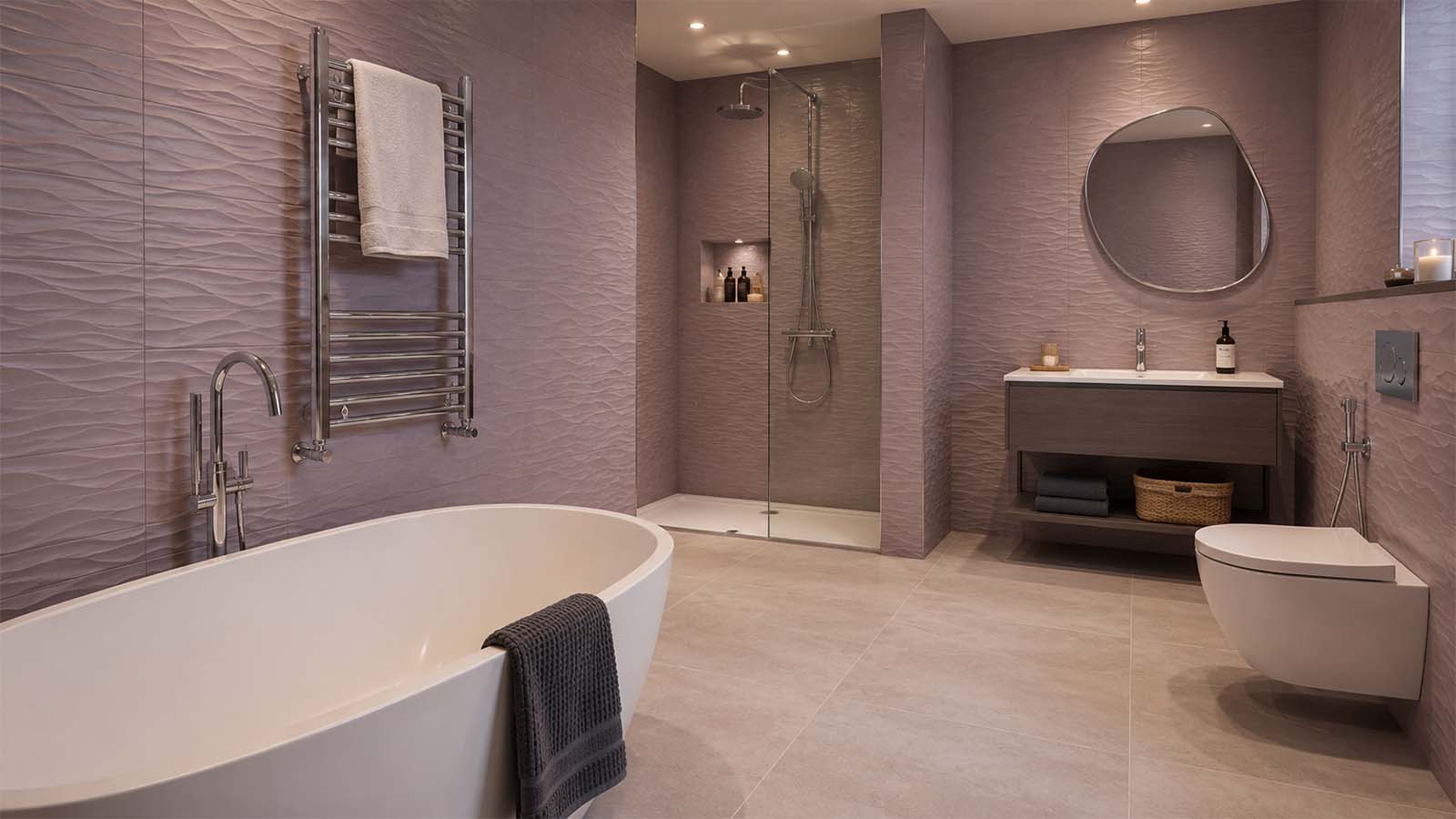
Cold at the top, warm at the bottom? Here's how to bleed a towel radiator in five easy steps: what you need, how long it takes, and when it isn't air.
The Towel That Never Quite Dries
You know the feeling. You hang a towel up after a shower, come back the next morning, and find that it is still faintly damp: cold, heavy, and smelling ever so slightly of a school changing room. So you put a hand on the rail. The bottom bar is hot enough to make you flinch, while the top bar is stone cold. Somewhere in the middle, the heat gives up entirely.
That is trapped air, the most common reason in Britain for a towel radiator not heating properly and the easiest problem on this list to fix yourself. No plumber, no draining down, and no dust sheets are required. All you need is a radiator key, a cloth, and the discipline to stop at the right moment.
Here is how to bleed a towel radiator properly, along with the quick check to do first. If your rail is cold at the bottom, bleeding it will achieve nothing except a wet floor.
The Short Answer
Turn the heating off and let the rail go cold. Hold a cloth under the radiator bleed valve at the top corner, then open it a quarter turn anticlockwise with a bleed key. Let the air hiss out. Close it the moment water appears, then check that your boiler pressure sits at 1 to 1.5 bar.
That's the job, How to bleed a heated towel rail is identical whether it's a ladder rail in the en suite or a flat panel in the downstairs loo. The rest of this guide is the detail that stops it going wrong.
Is It Actually Air? The Palm Test
Before you go rummaging in the drawer of doom for a radiator bleed key, put your palm flat on the rail and read it from top to bottom. It will tell you what's wrong in twenty seconds.
|
What you can feel |
What it usually means |
What to do about it |
|
Hot at the bottom, cold at the top |
Trapped air, a textbook towel radiator air lock |
Bleed it. Five minutes, start to finish |
|
Hot at the top, cold or patchy at the bottom |
Radiator sludge, the black iron silt called magnetite that settles low down |
Bleeding won't shift it. Needs flushing |
|
Cold all over, but the rest of the house is toasty |
A closed or seized valve, either the TRV or the lockshield valve |
Check the valves before anything else |
|
Cold all over, and so is everything else |
A boiler, pump or circulation fault |
Not a bleeding job. Ring an engineer |
|
Warm, but never properly hot |
Poor balancing, or restricted flow and return |
Open the lockshield, or get the system balanced |
The rule worth committing to memory is that air rises and sludge sinks. So, why is my towel radiator cold at the top? It is usually caused by trapped air. A towel radiator that is warm only at the bottom usually points to the same issue in reverse. However, a towel radiator that is cold at the bottom but hot at the top is more likely to be suffering from corrosion debris or sludge, and no amount of bleeding a heated towel rail will fix it.
Stop. Is Your Rail Electric?
Do electric towel radiators need bleeding? No. An electric rail is a sealed system in miniature, filled once at the factory with water and glycol, sealed, and left alone. There is no bleed valve because there is nowhere for air to get in.
So, why is my heated towel rail not heating up if it is electric? The cause is almost always the immersion element or the thermostat. Check the fused spur first, as it is usually located outside the bathroom door and may simply have been switched off. Then check the fuse, followed by the element.
Dual-fuel rails are the exception. They run on central heating in winter and an element in summer, so they are plumbed in and do have a bleed valve.
Your Kit List (Two Minutes of Prep)
- A radiator bleed key. The UK standard is a 5mm square clock key, though some designer rails take a screwdriver with a flat blade. If yours has vanished, a radiator maintenance kit costs a couple of quid and is worth keeping in the house, because you will need it again.
- An old cloth. Held under the valve, not draped over it.
- A small container. A mug, a tub, a takeaway box. What comes out can be black, and it stains grout in a way that outlives the marriage.
Can you bleed a towel radiator yourself? Yes. It's one of the few heating jobs designed for the homeowner. Nothing notifiable, no gas work, no certificate.
Step 1: Kill the Heat, Then Wait
Not turn the thermostat down. Off. Then wait, thirty minutes minimum, an hour if you've got the patience.
That water sits at around 60 to 70°C under pressure, and cracking a valve on a hot system gives you a jet of scalding water at exactly wrist height. With the pump running, air is shoved round the circuit rather than sitting still. Let it settle and it gathers where it always gathers, at the top bar.
Use the wait to move the bath mat.
Step 2: Hunt Down the Bleed Valve
Look at the top corner of the rail, on the opposite side to the pipework. If the valves come in at the bottom left, the bleed valve is top right. It's a small brass or chrome fitting about the size of a five-pence piece, with a square peg or a slot in the middle.
Ladder towel radiator designs are where people come unstuck. The valve tucks into the corner where the upright meets the top bar, and on chrome rails it blends in so well you'll look past it three times. Get a torch on it, because bathroom lighting is designed for flattery, not plumbing.
Nothing there at all? Either it's electric, or it's on the back of the top bar.
Step 3: A Quarter Turn, and Listen
Push the key firmly onto the peg, square on rather than perched at an angle, or you'll round it off. Cloth in the other hand, held underneath. Container below that.
Turn anticlockwise. A quarter turn. That's all.
You'll hear the hiss straight away, a thin, steady note somewhere between a bicycle tyre and a disappointed sigh. That's the trapped air leaving, and that sound is the entire reason you're here. It might last two seconds. On a badly airlocked rail, twenty.
A quarter is enough because you're breaking a seal, not opening a tap. A full turn risks unscrewing the spindle clean out of its housing, at which point system pressure introduces you, personally, to fifteen years of heating water. People do this. Don't be people.
That hiss is all that removing air from a towel radiator amounts to. The rest is just not making a mess.
Step 4: Shut It the Second Water Shows
This is the step people get wrong, so read it twice.
The hiss thins, spits, then turns into a dribble of water. That's your cue. Close it. Now. Not after a bit more to be sure. The moment you see a steady bead, the air is out, and everything after that is simply your heating system emptying onto the floor while the boiler pressure drops with it.
Turn clockwise until snug. Snug, not cranked. You're seating a small washer against a brass fitting, and leaning on it too hard can leave you with a valve that quietly weeps for six months. Fingertip pressure is plenty.
Clear water means a healthy system. Black water means there's a different conversation to be had, and we'll come to that shortly. Bleed the other cold radiators before you go anywhere near the boiler.
Step 5: Rescue Your Boiler Pressure
Every bleed drops your pressure, because you've removed volume from a sealed circuit. One rail might cost you 0.1 bar. Six in an afternoon can drop the boiler below its minimum, at which point it sulks, flashes a fault code and refuses to fire.
Look at the pressure gauge on the boiler. When cold, it should read between 1 and 1.5 bar, and most manufacturers recommend approximately 1.2 bar. It climbs to near 2 bar once the heating's running, which is normal.
Below 1 bar, top up with the filling loop, the braided silver hose underneath with a small valve at each end. Open both slowly, listen for water, watch the needle, and close them at 1.2. Short bursts. Overshoot past 2.5 and you're bleeding pressure back out again.
No gauge? You've got an open-vented system with a tank in the loft, which tops itself up. Nothing to do.
Fire the heating up and feel the rail after twenty minutes. It should be hot corner to corner.
Big House? Bleed in This Order
Doing the whole property rather than one rail? The order matters, and getting it right costs you nothing.
Start downstairs, with the radiator furthest from the boiler. Work back towards the boiler. Then go upstairs and do the same again.
You're chasing air ahead of you and upwards, rather than dragging it back through roads you've already done. Bleed the upstairs bathroom first, and air settles back into it by teatime, leaving you standing there with the key again.
Check the pressure once at the end, not after every rad.
Why Your Towel Rail Always Goes First
It's tall, and air goes up. In most bathrooms the top bar is the highest point of pipework in the room, sometimes on the whole circuit. Air climbs and stops. Your rail is the summit.
The bars are thin. A ladder rail is a series of narrow tubes: small bore, low water volume, low flow. Barely any air is needed to block one, where the same pocket in a fat panel radiator would register as nothing worse than cold spots.
It's often last on the run. Bathrooms tend to sit at the end of the circuit, often retrofitted years later by someone in a hurry. Least flow, furthest to travel, highest point. It never stood a chance.
That isn't a fault, it's physics. It's also why towel radiator maintenance is really just an annual appointment with a cloth.
Bled It, and It's Still Stone Cold?
The TRV is seized. Far and away the most common culprit. Thermostatic radiator valve pins stick down after a summer spent closed, and a stuck pin means no flow, whatever the dial says. Unscrew the plastic head and press the metal pin underneath. It should spring back. If it's rigid, work it up and down with pliers. Nine times out of ten, it frees with an audible pop, and the rail is hot within the hour. If not, replacing the towel radiator valve is a straightforward job.
The lockshield is closed. The valve with the plastic cap at the other end sets how much flow this rail gets compared with every other radiator in the house. Pop off the cap, open it a turn or two with a spanner, and note where it started, because fiddling with it upsets the balance of the whole system.
It's sludge. Cold at the bottom, hot at the top, and bleed water the colour of stewed tea. That's magnetite, and it calls for a flush, a magnetic filter, and a proper dose of heating system inhibitor. A power flush is the professional solution. It costs real money, but it's cheaper than a new pump.
It's the pump. Is the whole house lukewarm, with nothing you do to one rail making a difference? Stop, because that's an engineer's job. A towel radiator not getting hot is nearly always caused by one of those four issues.
How Often, and Why It Keeps Coming Back
How often should you bleed a towel radiator? Once a year, in early autumn, the weekend you first switch the heating on. Ten minutes in September saves a fortnight of clammy towels in November.
Every few months, though, something's genuinely wrong. Air shouldn't enter a sealed system at that rate. The usual suspects:
- A small leak on the negative side of the pump, quietly drawing air in
- A failed automatic air vent, letting air in rather than out
- An expansion vessel that's lost its charge, so pressure swings between hot and cold
- Corrosion. When the inhibitor runs out, the system starts eating itself and gives off hydrogen as it goes. Black water and a monthly bleed are a sign that the system is chemically unprotected
One note on that last one. The gas coming off a badly corroding system is flammable, so however tempting it is to hold a lighter to the valve, don't.
Two Moments to Down Tools and Ring a Pro
The water won’t stop. The key is turned clockwise and is snug, but the valve is still dribbling. The washer's gone, or the spindle's stripped. Isolate the rail: turn the TRV to zero, close the lockshield with a spanner, put a bowl underneath, then call a plumber. Don't force the key, or you'll shear the peg off and turn a small job into a large one.
The water is black, and there's plenty of it. Slight discolouration is normal in an older system. Genuinely black, gritty water that keeps coming means the whole system needs attention, not just this rail.
Anything involving the boiler, the pump or a pressure drop you can’t explain is a job for a Gas Safe-registered engineer. Bleeding is DIY. Boilers aren't.
When the Rail Itself Is the Problem
Sometimes you do everything right, and the honest answer is that the rail was never up to the room.
If you're weighing up how to improve towel radiator performance, the wins are boring but real. Fit decent towel radiator valves so you can control it, keep the system dosed, and don't hang three bath sheets on it and expect the room to warm up. A rail buried in wet towels heats the towels, not you.
If it's genuinely finished, a replacement towel radiator is an afternoon's work for a plumber. Modern rails run efficiently at lower flow temperatures, which matters more every year as heat pumps arrive, so an energy-efficient heated towel rail sized properly for the room will comfortably outperform a tired one. A chrome towel radiator still looks the part in a classic bathroom, though it trades a little output for the shine, while an anthracite towel radiator or black towel radiator gives noticeably more heat for the same footprint. On the electric side, a programmable towel radiator pays for itself quietly: an hour before you're up, an hour after the school run, nothing in between.
Measure your pipe centres before you order. Everyone forgets. Everyone regrets it.